



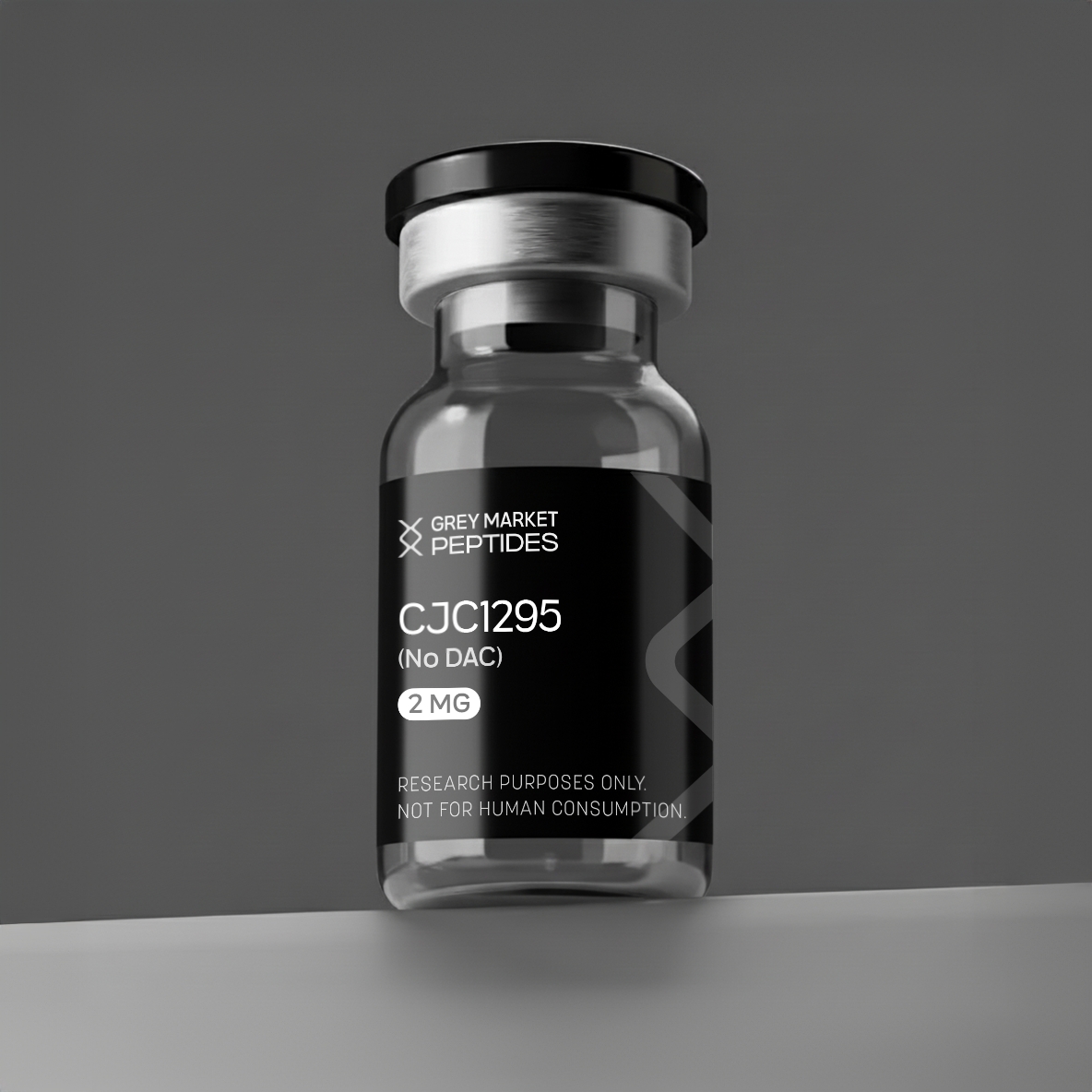
CJC-1295 (No DAC)
CJC-1295 (No DAC) is a synthetic analog of growth hormone-releasing hormone (GHRH) studied for its interaction with receptor signaling pathways and endocrine research models.
This peptide is for research purposes only. Not for human consumption.
Description
GHRH Analog and Receptor Interaction
CJC-1295 (No DAC) is examined for how GHRH analogs interact with receptor systems and downstream signaling markers [1]. The “No DAC” format is often discussed in terms of shorter persistence compared to DAC-modified analogs, supporting study designs focused on clearer time-course behavior and degradation patterns.
Endocrine Pathway Research Context
Research literature discusses GHRH analogs in the context of endocrine signaling and feedback modeling [2]. In controlled systems, researchers may track pathway markers, receptor sensitivity, and signaling amplitude to better understand how peptide analogs influence receptor-linked networks.
Kinetics, Timing, and Assay Design
CJC-1295 (No DAC) commonly appears in studies where timing and receptor-binding behavior are central. Researchers may use it in comparative assays to examine activation patterns, signal duration, and structure-function relationships relevant to GHRH analog design [1,2].
Key Specs
- Class: GHRH analog (No DAC)
- Research context: receptor signaling, endocrine pathway modeling, kinetics studies
- References: PubChem and PubMed [1,2]
Referenced Citations
- PubChem, CJC-1295: https://pubchem.ncbi.nlm.nih.gov/compound/CJC-1295
- PubMed, GHRH analogs and endocrine signaling context: https://pubmed.ncbi.nlm.nih.gov/18981485/
GHRH Analog and Receptor Interaction
CJC-1295 (No DAC) is examined for how GHRH analogs interact with receptor systems and downstream signaling markers [1]. The “No DAC” format is often discussed in terms of shorter persistence compared to DAC-modified analogs, supporting study designs focused on clearer time-course behavior and degradation patterns.
Endocrine Pathway Research Context
Research literature discusses GHRH analogs in the context of endocrine signaling and feedback modeling [2]. In controlled systems, researchers may track pathway markers, receptor sensitivity, and signaling amplitude to better understand how peptide analogs influence receptor-linked networks.
Kinetics, Timing, and Assay Design
CJC-1295 (No DAC) commonly appears in studies where timing and receptor-binding behavior are central. Researchers may use it in comparative assays to examine activation patterns, signal duration, and structure-function relationships relevant to GHRH analog design [1,2].
Key Specs
- Class: GHRH analog (No DAC)
- Research context: receptor signaling, endocrine pathway modeling, kinetics studies
- References: PubChem and PubMed [1,2]
Referenced Citations
- PubChem, CJC-1295: https://pubchem.ncbi.nlm.nih.gov/compound/CJC-1295
- PubMed, GHRH analogs and endocrine signaling context: https://pubmed.ncbi.nlm.nih.gov/18981485/
Reviews
There are no reviews yet.