



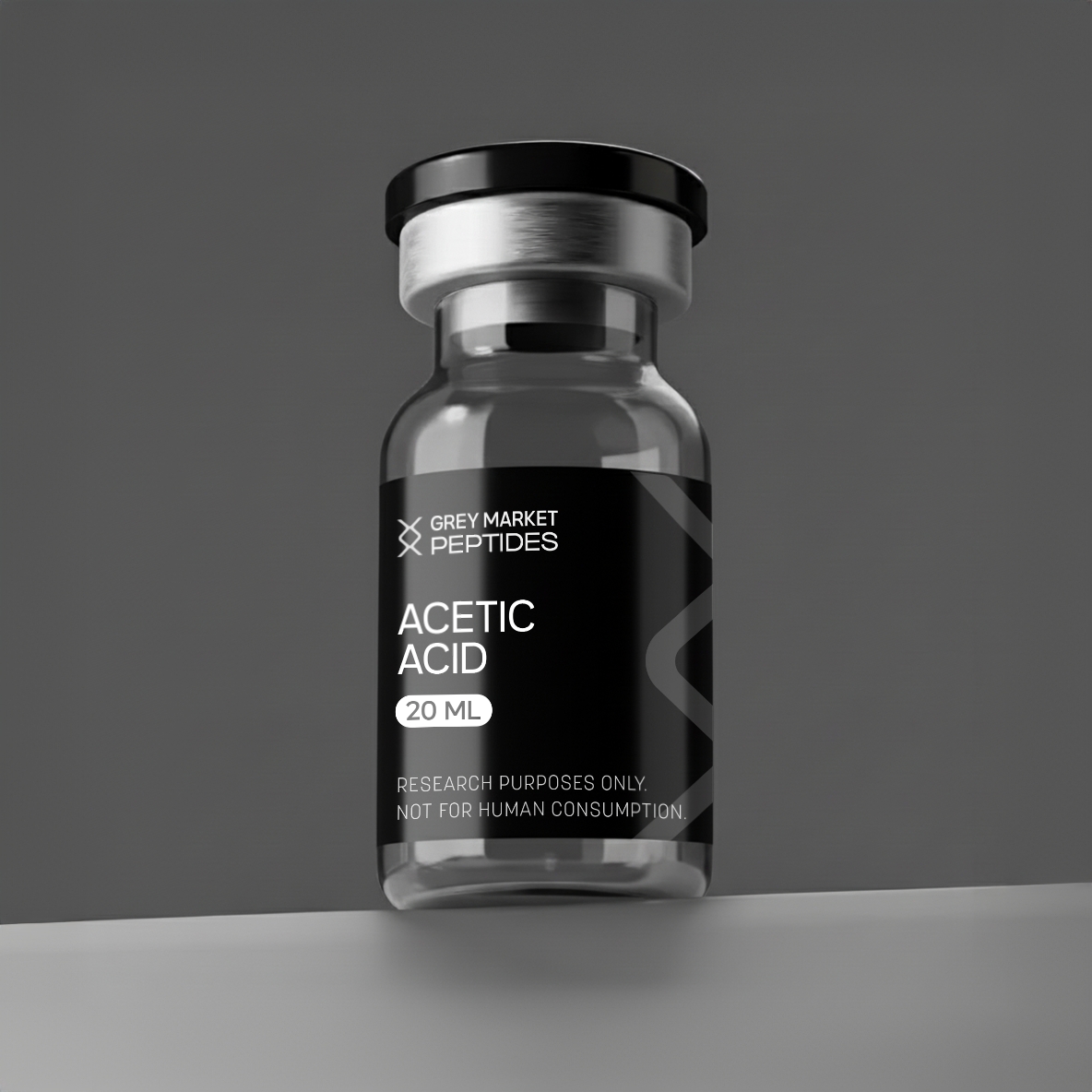
Acetic Acid (0.6%)
Acetic Acid (0.6%) is widely referenced in peptide formulation and biochemical workflows as a mild acidic solvent. It is commonly evaluated for its influence on solubility behavior, charge state, and short-term solution stability under controlled experimental conditions [1].
This peptide is for research purposes only. Not for human consumption.
Description
Peptide Solubility and Charge Modulation
Low-concentration acetic acid solutions are frequently examined to address solubility challenges associated with hydrophobic or aggregation-prone sequences. Acidic environments can alter peptide ionization states, which may reduce intermolecular attractions linked to precipitation [1,2]. Researchers often compare dilute acetic acid with neutral aqueous systems to evaluate differences in dissolution efficiency, clarity, and repeatability. These observations support formulation screening and help characterize solvent-dependent behavior across different peptide classes and molecular weights.
Physicochemical Characteristics
Acetic acid is a small, well-characterized carboxylic acid with predictable behavior in aqueous systems. At low concentrations, it offers consistent pH control and remains broadly compatible with common experimental workflows [1]. Its volatility and water miscibility support controlled handling and reproducibility across standard lab procedures. These properties are extensively documented in analytical and biochemical literature, making acetic acid a common benchmark solvent component in method development.
Analytical and Workflow Applications
Beyond peptide dissolution studies, acetic acid is referenced in chromatography, buffer preparation, and protein analysis workflows [2]. Its established chemical profile allows researchers to isolate solvent effects from peptide-specific variables, enabling cleaner comparisons during stability checks, solubility screening, and method optimization.
Key Specs
- Concentration: 0.6% acetic acid in water
- Common research context: solvent system evaluation, peptide solubility screening, analytical workflows
- Documentation: PubChem and NCBI references included [1,2]
Referenced Citations
- PubChem, Acetic Acid: https://pubchem.ncbi.nlm.nih.gov/compound/Acetic-acid
- NCBI Bookshelf, Acetic Acid and biochemical applications: https://www.ncbi.nlm.nih.gov/books/NBK548561/
Peptide Solubility and Charge Modulation
Low-concentration acetic acid solutions are frequently examined to address solubility challenges associated with hydrophobic or aggregation-prone sequences. Acidic environments can alter peptide ionization states, which may reduce intermolecular attractions linked to precipitation [1,2]. Researchers often compare dilute acetic acid with neutral aqueous systems to evaluate differences in dissolution efficiency, clarity, and repeatability. These observations support formulation screening and help characterize solvent-dependent behavior across different peptide classes and molecular weights.
Physicochemical Characteristics
Acetic acid is a small, well-characterized carboxylic acid with predictable behavior in aqueous systems. At low concentrations, it offers consistent pH control and remains broadly compatible with common experimental workflows [1]. Its volatility and water miscibility support controlled handling and reproducibility across standard lab procedures. These properties are extensively documented in analytical and biochemical literature, making acetic acid a common benchmark solvent component in method development.
Analytical and Workflow Applications
Beyond peptide dissolution studies, acetic acid is referenced in chromatography, buffer preparation, and protein analysis workflows [2]. Its established chemical profile allows researchers to isolate solvent effects from peptide-specific variables, enabling cleaner comparisons during stability checks, solubility screening, and method optimization.
Key Specs
- Concentration: 0.6% acetic acid in water
- Common research context: solvent system evaluation, peptide solubility screening, analytical workflows
- Documentation: PubChem and NCBI references included [1,2]
Referenced Citations
- PubChem, Acetic Acid: https://pubchem.ncbi.nlm.nih.gov/compound/Acetic-acid
- NCBI Bookshelf, Acetic Acid and biochemical applications: https://www.ncbi.nlm.nih.gov/books/NBK548561/
Reviews
There are no reviews yet.